Springs used in demanding environments must maintain their mechanical properties and dimensional stability despite exposure to moisture, chemicals, temperature changes, and other corrosive conditions. Corrosion can weaken spring materials, alter their surface condition, and eventually contribute to premature failure. This makes corrosion resistance an important consideration when specifying precision springs for oil and gas, marine, medical, and other applications with challenging operating conditions.
Choosing the right material, surface treatment, and manufacturing approach can help protect custom extension springs, custom torsion springs, and other spring designs throughout their service life. Early consideration of the operating environment allows manufacturers to select solutions that balance corrosion resistance, performance, and application requirements.
Common Causes of Spring Corrosion
Moisture, Chemicals, and Heat
Moisture is one of the most common contributors to spring corrosion, particularly when springs are exposed to water, humidity, condensation, or saltwater. Marine applications can be especially demanding because salt and moisture can accelerate corrosion on susceptible metals. Oil and gas equipment may also expose springs to chemicals, hydrocarbons, saltwater, and other substances that can affect material performance.
Temperature can further influence corrosion. Elevated temperatures may accelerate chemical reactions and increase the effects of corrosive substances, while repeated heating and cooling can contribute to condensation and changing environmental conditions. Medical equipment may face different concerns, including cleaning agents, sterilization processes, and moisture exposure.
The spring’s design and operating conditions should therefore be considered together. Precision springs used in harsh environments need materials and finishes suited to the specific combination of temperature, moisture, chemicals, loading, and exposure time.
Material Selection Strategies
Stainless and Exotic Alloys
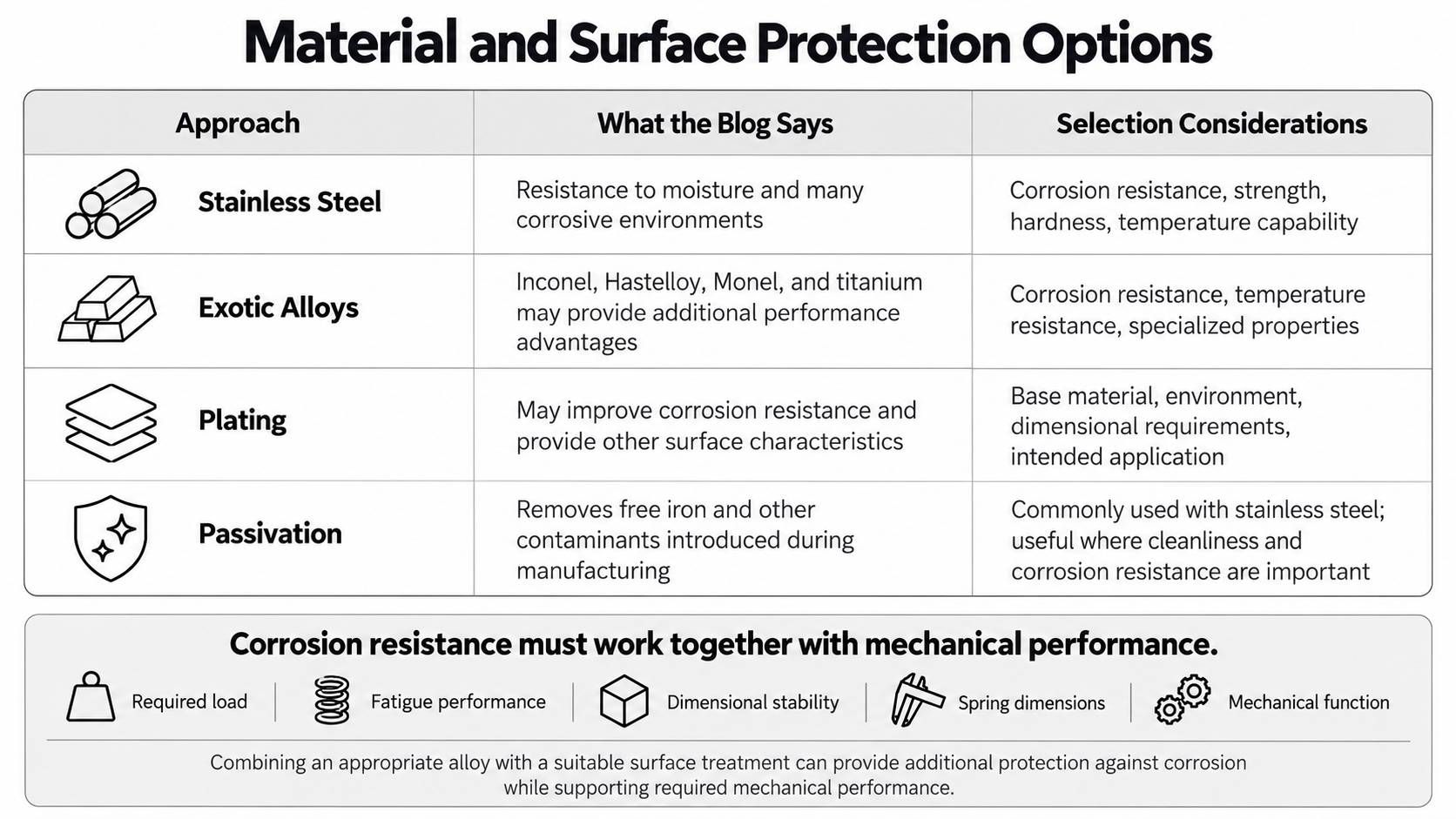
Material selection is an important first step in controlling corrosion. Stainless steel is commonly selected for applications where resistance to moisture and many corrosive environments is required. Different stainless grades provide different combinations of corrosion resistance, strength, hardness, and temperature capability, so the appropriate grade depends on the application.
For particularly demanding environments, exotic alloys may provide additional performance advantages. Materials such as Inconel, Hastelloy, Monel, and titanium can be considered where corrosion resistance, temperature resistance, or other specialized properties are required. These materials can be used in custom extension springs and custom torsion springs when standard spring materials may not meet the application’s requirements.
Material selection should also account for spring stresses and operating conditions. A corrosion-resistant material still needs to provide the required load, fatigue performance, and dimensional stability throughout the intended service life.
Coatings and Surface Treatments
Plating and Protective Finishes
Surface treatments can provide another layer of protection against environmental exposure. Plating may improve corrosion resistance while also providing other surface characteristics, depending on the selected finish. The appropriate treatment depends on the base material, environment, dimensional requirements, and intended application.
Passivation is commonly used with stainless steel to improve the corrosion resistance of the surface by removing free iron and other contaminants introduced during manufacturing. This can be particularly useful for components used in applications where cleanliness and corrosion resistance are important, including certain medical and industrial equipment.
Other protective finishes may be considered based on the operating environment and performance requirements. For precision springs, the treatment must also be compatible with the spring’s dimensions and mechanical function. A coating that adds excessive thickness or affects the spring surface could influence performance, particularly on tightly controlled components.
For custom torsion springs and custom extension springs, manufacturers can evaluate material and finishing requirements as part of the overall spring design. Combining an appropriate alloy with a suitable surface treatment can provide additional protection against corrosion while supporting the spring’s required mechanical performance.
Plan for Longer-Lasting Spring Performance
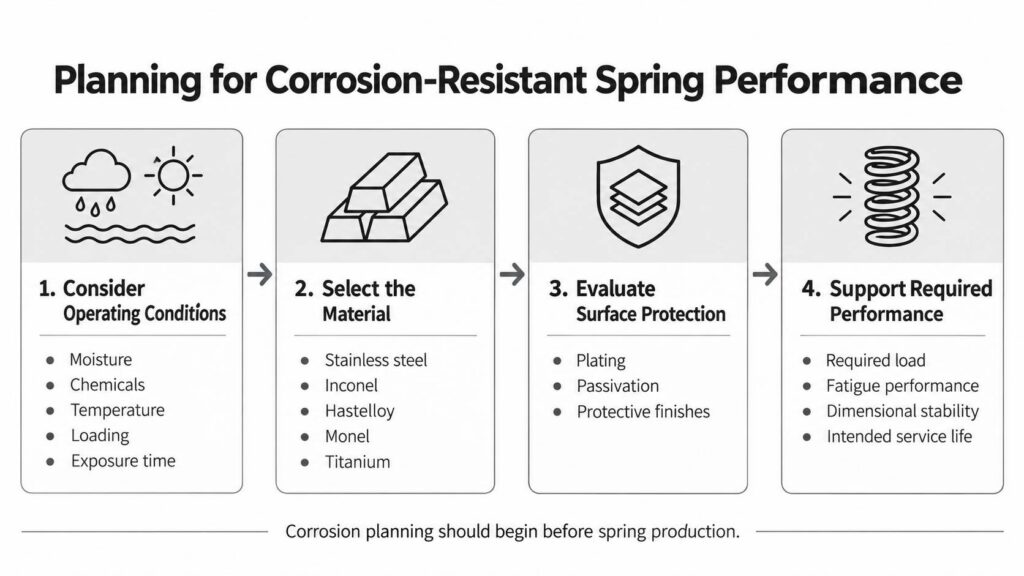
Corrosion planning should begin before spring production, with consideration given to the environment, material, loading conditions, temperature, and required service life. Selecting suitable materials and protective treatments can help reduce corrosion-related degradation and support reliable spring performance.
Need corrosion-resistant spring solutions for your application? Contact Argo Spring & Screw Machining Manufacturing to discuss your requirements.