For high-cycle applications, the purchase price of a spring is only one part of its overall cost. A spring that wears out prematurely can lead to replacement expenses, production interruptions, maintenance labor, and potential damage to surrounding components. Lifecycle thinking helps engineers evaluate how design, materials, manufacturing, and testing affect long-term performance. For precision springs, considering these factors from the beginning can help control total cost of ownership while supporting reliable operation.
Key Drivers of Spring Lifecycle Cost
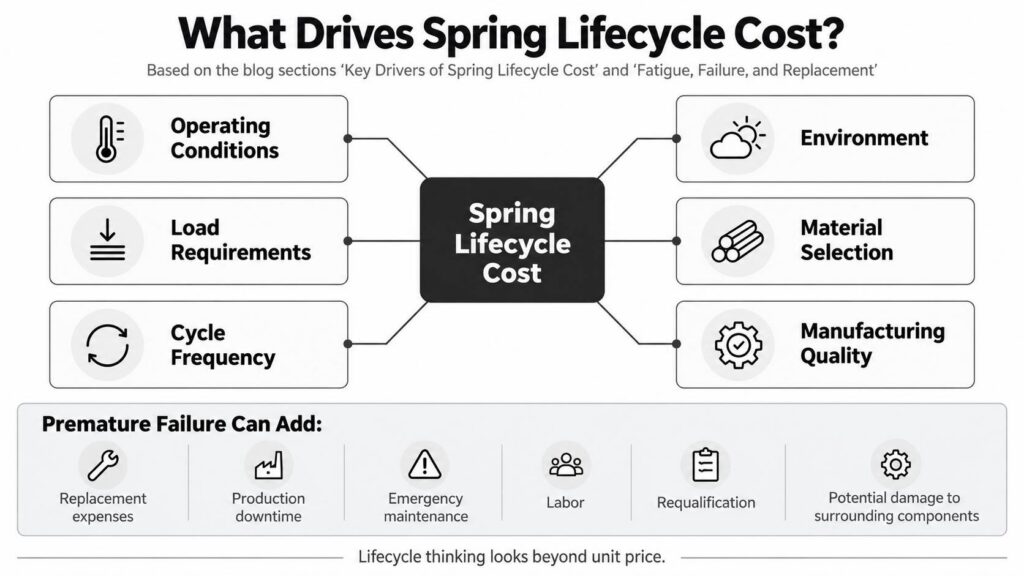
Spring lifecycle cost is influenced by more than the number of parts purchased. Operating conditions, load requirements, cycle frequency, environment, material selection, and manufacturing quality can all affect service life.
Applications with frequent cycling place repeated stress on spring components. Properly accounting for these conditions during design can help reduce premature wear and fatigue. A spring that is appropriately sized and manufactured for its application may provide more consistent performance over its expected service life.
Fatigue, Failure, and Replacement
Fatigue is a major consideration for springs subjected to repeated loading. Each cycle can contribute to material fatigue, particularly when stresses approach the material’s limits. Improper dimensions, excessive stress, unsuitable materials, or operating conditions outside the original design requirements can shorten service life.
Premature failure can create costs beyond the replacement part itself. Production downtime, emergency maintenance, labor, and requalification may all add to the total expense. Designing compression springs and other spring types around actual operating conditions can help reduce these risks.
Design and Material Decisions
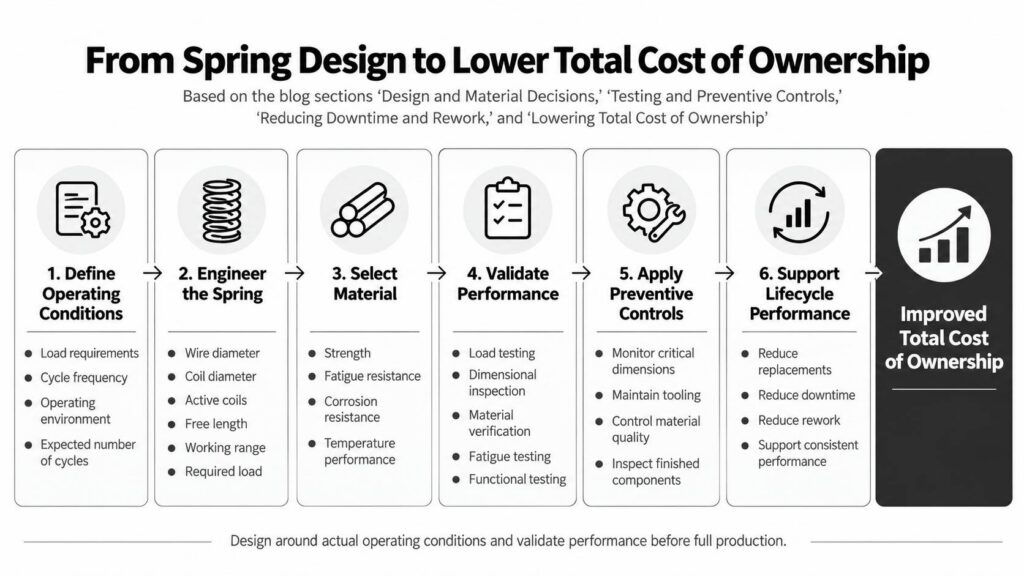
Spring geometry has a direct effect on performance and durability. Engineers should consider factors such as wire diameter, coil diameter, number of active coils, free length, working range, and required load. These characteristics should be evaluated alongside the expected number of cycles and operating environment.
Material selection is equally important. Different spring materials provide varying levels of strength, fatigue resistance, corrosion resistance, and temperature performance. Selecting a material based on the actual application rather than initial material cost can support longer service life.
Balancing Performance and Longevity
The goal is not simply to make a spring stronger or larger. An effective design balances performance requirements with the expected operating conditions. For custom torsion springs, factors such as winding direction, leg configuration, torque requirements, and angular deflection should be considered together to avoid excessive stress during operation.
For compression springs, engineers should evaluate the required load, working deflection, solid height, and cycle requirements. Building sufficient margin into the design without unnecessarily increasing material or manufacturing costs can help balance longevity and overall part cost.
Testing and Preventive Controls
Testing can provide valuable information about whether a spring design will perform as expected. Depending on the application, testing may include load testing, dimensional inspection, material verification, fatigue testing, or functional testing under simulated operating conditions.
For precision springs, testing can help identify potential performance issues before components enter full production. Establishing appropriate inspection and quality controls can also help maintain consistency between production lots.
Reducing Downtime and Rework
Preventive controls can reduce the likelihood of unexpected failures. Monitoring critical dimensions, maintaining tooling, controlling material quality, and inspecting finished components can help identify variation before it results in costly production issues.
Working with an experienced manufacturer can also help engineers review spring designs before production. For custom torsion springs and other specialized components, early collaboration can identify potential fatigue, material, or manufacturing concerns while changes are still easier to make.
Lowering Total Cost of Ownership
Lifecycle optimization starts with looking beyond unit price. Selecting appropriate materials, designing around actual operating conditions, and validating performance through testing can help extend spring service life and reduce unexpected costs.
For precision springs and compression springs, a lifecycle-focused approach can reduce replacements, downtime, and rework while supporting consistent performance. Careful engineering of custom torsion springs and other spring components can likewise help reduce long-term risk and improve total cost of ownership.
Talk with Argo Spring & Screw Machining Manufacturing about spring solutions built for long-term performance and cost efficiency.