Tight tolerances can be essential for parts that must fit precisely, perform consistently, or meet demanding assembly requirements. However, specifying tighter tolerances than necessary can increase manufacturing risk, inspection requirements, scrap, and cost. This is particularly important for springs and wire forms, where material behavior and forming processes can affect final dimensions. Early collaboration with an experienced manufacturer can help engineers establish practical specifications for precision springs, precision wire forms, and other components.
Defining Critical vs Non-Critical Tolerances
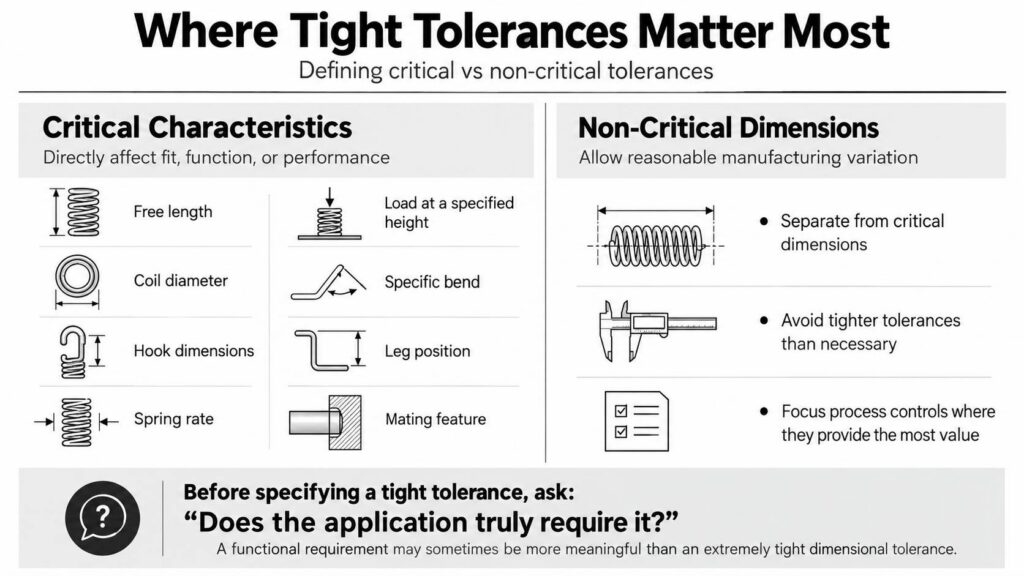
Start by identifying which dimensions directly affect a component’s fit, function, or performance. For a spring, critical characteristics may include free length, coil diameter, hook dimensions, spring rate, or load at a specified height. A wire form may require tighter control around a specific bend, leg position, or mating feature.
Separating critical from non-critical dimensions allows manufacturers to focus process controls and inspection resources where they provide the most value. For precision springs, a functional requirement such as load at a specific height may sometimes be more meaningful than an extremely tight dimensional tolerance.
Avoiding Over-Specification
Before applying a tight tolerance, determine whether the application truly requires it. Consider how much variation the assembly can accommodate and whether a functional requirement could provide a better specification.
GD&T can also communicate design intent without unnecessarily restricting every dimension. Appropriate datum references, position controls, and profile tolerances can define relationships between features while giving the manufacturer reasonable process flexibility.
Design for Manufacturability
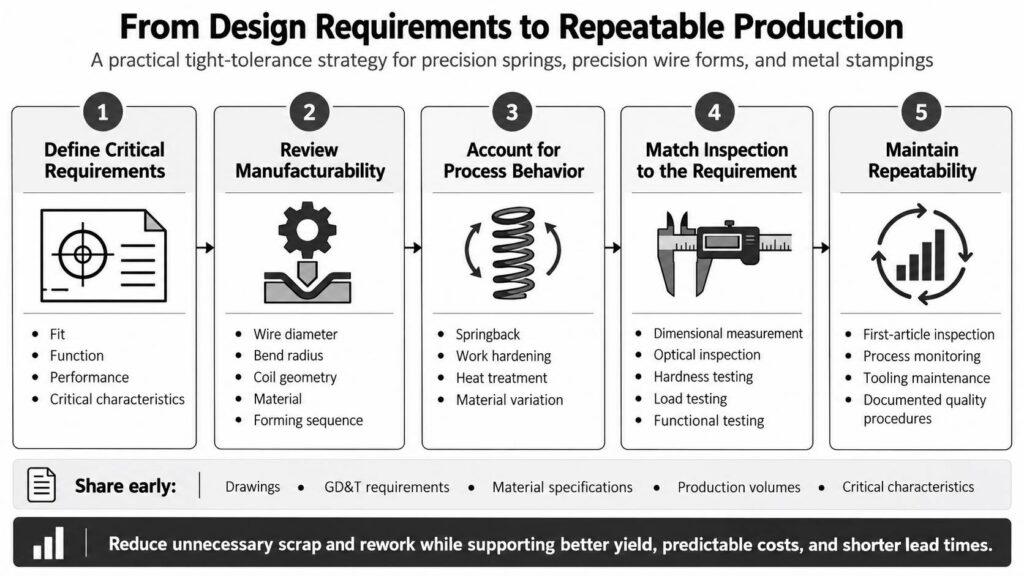
Design for manufacturability should be considered before production begins. For springs and wire forms, wire diameter, bend radius, coil geometry, material, and forming sequence can influence achievable tolerances.
The same principle applies to metal stampings. Features that are extremely small, closely spaced, or difficult to access may require specialized tooling or additional operations. Reviewing these requirements with the manufacturer early can identify opportunities to simplify a design without compromising performance.
Material Behavior and Process Limits
Materials can change dimensions during forming and finishing. Springback, work hardening, heat treatment, and material variation can all affect final results.
Engineers should account for these factors when selecting materials and establishing tolerances. For precision wire forms, material characteristics and bend geometry can have a direct effect on final dimensions. Discussing these factors with the manufacturer can help establish realistic process limits before production.
Inspection and Process Control
Tight-tolerance components require inspection methods that match their critical requirements. Depending on the part, inspection may include dimensional measurement, optical inspection, hardness testing, load testing, or functional testing.
For precision springs, load testing can verify performance when force at a particular height is more important than a single dimensional measurement. SPC can also help identify process trends before they result in significant quantities of nonconforming parts.
Maintaining Repeatability at Scale
Meeting a tolerance during prototyping does not automatically guarantee repeatability during production. Tool wear, material lots, equipment variation, and production volume can affect consistency.
Manufacturers producing metal stampings, precision springs, and precision wire forms can use first-article inspection, process monitoring, tooling maintenance, and documented quality procedures to maintain repeatability. Sharing drawings, GD&T requirements, material specifications, production volumes, and critical characteristics early gives the supplier an opportunity to identify potential manufacturing limitations before production.
Tight Tolerances, Smarter Choices
Tight tolerances should serve a clear engineering purpose. By separating critical from non-critical dimensions, avoiding unnecessary specifications, applying GD&T appropriately, and accounting for material and process behavior, engineers can create parts that are both precise and manufacturable.
For precision springs, precision wire forms, and metal stampings, early communication with the manufacturing supplier can also help establish practical inspection and process-control requirements. A smart tolerance strategy can reduce unnecessary scrap and rework while supporting better yield, predictable costs, and shorter lead times.
Talk with Argo about your next tight-tolerance project and find the right approach for your application.